Deploy flows to the Postman cloud
You can deploy any flow to the Postman cloud, where it can receive and respond to requests from collaborators and other users. Flows running in the cloud can be scheduled, or triggered by external systems like third-party services, other APIs, or webhooks. Flows in the cloud are useful for running automations and exposing functionality as an API or as an AI tool for MCP servers.
For more information about running flows in the cloud, see Deployed flows overview.
Flows in Local View can’t be deployed. To learn more, see Manage flows locally or in the Postman Cloud.
Flows running in the Postman cloud don’t support private APIs.
Deployable flows are available in Postman version 11.42.3 and later.
Create a deployable flow
To create a flow you can run in the cloud, do the following:
-
On the Start block, click Change trigger and select
 Request.The Start block becomes a Request block.
 -
Add and connect blocks to create a flow that processes data from one or more of the Request block’s output ports.
-
Add a Response block. Connect other blocks’ outputs to the Response block’s Headers and Body inputs as necessary. This will return status codes and include routed data in the response’s headers and body according to your requirements.
-
Click Run to test your flow locally with scenario data.
You can design your flows to be synchronous (sync) or asynchronous (async). In a sync flow, all the blocks complete their functions before the flow sends a response. An async flow running in the cloud sends a response before its blocks finish running. For more information, see Synchronous and Asynchronous deployed flows.
Deploy a flow
After you create a flow with a Request block and a Response block, you can deploy it to make it publicly available. For more information about deploying flows, see Deploy flows with snapshots.
To deploy a new flow to the cloud, do the following:
-
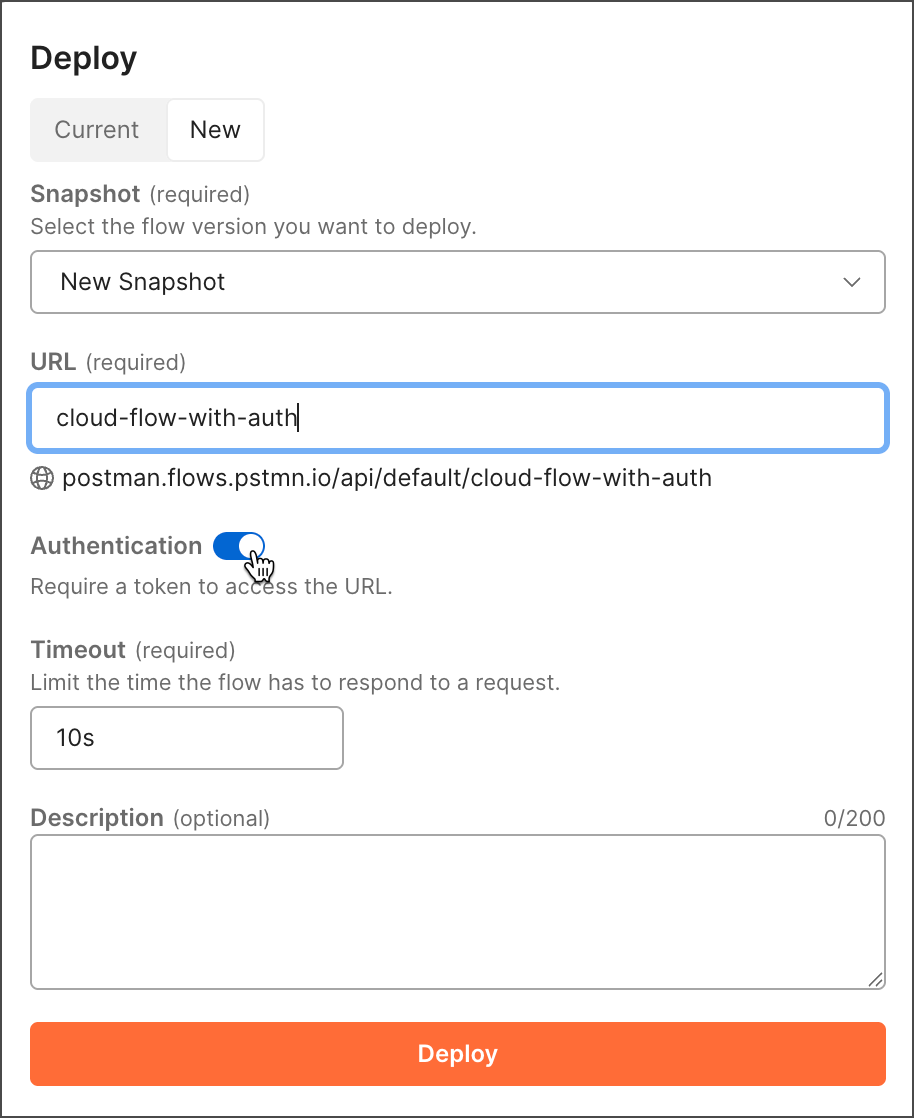
In your flow, click Deploy and enter the following:
-
URL - This path will be added to the domain where the flow is deployed. You can use the resulting URL to call the flow.
-
Authentication - (Optional) Turn this on to require a token to access the URL.
-
Timeout - Sets the amount of time that the flow will wait before sending a 408 Request Timeout error if it hasn’t finished running. Enter a value between 5 and 30 seconds (inclusive). For more information, see Manage long-running deployed flows.
-
Description - (Optional) Describe the flow’s purpose and any important details.
-
-
Click Deploy. The flow runs in the Postman cloud at the specified URL. In the Deploy window, click Current to see a summary of the flow. The summary includes the flow’s status (online or offline), last deployed date and snapshot version, and authentication setting.
Deploy a new snapshot of a flow
If you make changes to your flow, you can deploy the new version and create a new snapshot of it.
To deploy a new version of an existing flow, do the following:
-
In your flow, click Deploy.
-
(Optional) Enter a description of the changes.
-
Click Deploy. The new version of the flow is deployed to the original URL and a new snapshot is created.
Deploy a previous snapshot of a flow
To revert a flow to a previous snapshot, do the following:
-
In your flow, click Deploy > New.
-
Click the
 New Snapshot dropdown list.
 -
Select the snapshot you want to deploy.
-
Click Deploy.
The local version of your flow doesn’t automatically restore the snapshot when you deploy it. To learn about restoring snapshots and more, see Version flows with snapshots.
Schedule a flow to run automatically
You can trigger flows in the cloud to run at regular intervals or at specific times.
To trigger a flow with a schedule, do the following:
-
In the Request block in your flow, click Change trigger and select
 Schedule. The Request block changes to a Schedule block.
 -
In the text box, enter when you want the flow to run in plain language. For example, you could enter “Run once per minute for five minutes.” The shortest time increment you can schedule is one minute. The longest is one year.
-
Click Apply.
-
Click Deploy > New > Deploy. You can see the flow’s results on the Analytics page after it runs.
Enforce bearer token authorization
You can configure new and existing flows to authorize requests with a bearer token. To require a bearer token for a new flow, do the following:
-
Click Deploy.
-
Enter a URL.
-
Turn on Authentication.
-
Click Deploy.
-
In the Deploy window, click Current. The obfuscated token appears at the bottom of the Deploy window.
-
Hover over the token and click
 Copy to copy the token. You can then share the token with authorized users so they can include it in requests to the flow’s URL.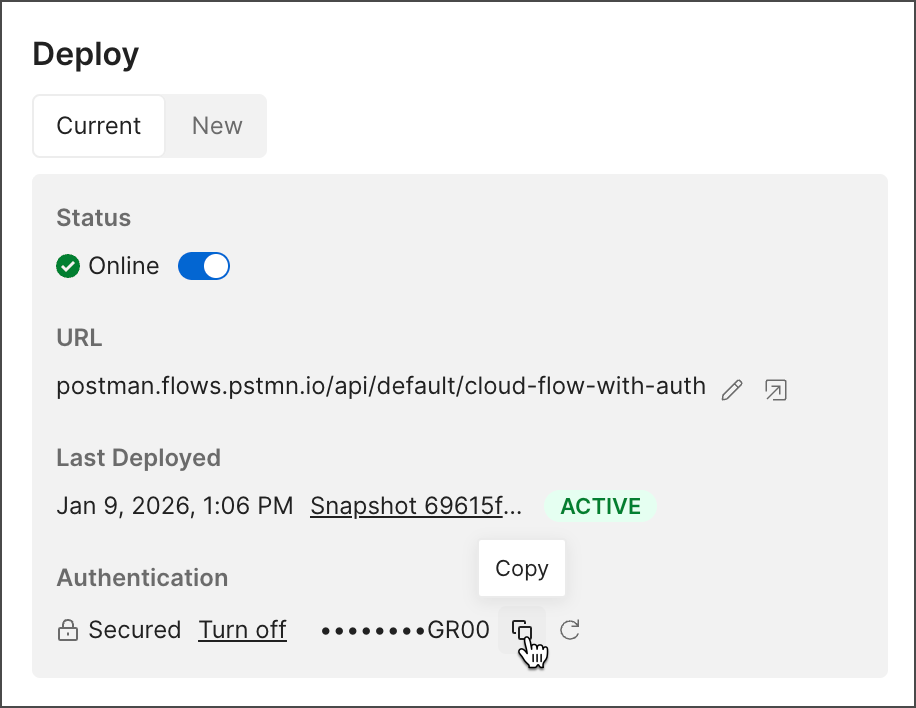
-
(Optional) Hover over the token and click
 Regenerate token to create a new token.