Overview
Postman Fabric Gateway is a protocol-agnostic, multi-agent-native control plane that unifies how agents (coding, business, and background) discover, call, and collaborate with tools, APIs, CLIs, and other agents, all governed by Postman-centric policies.
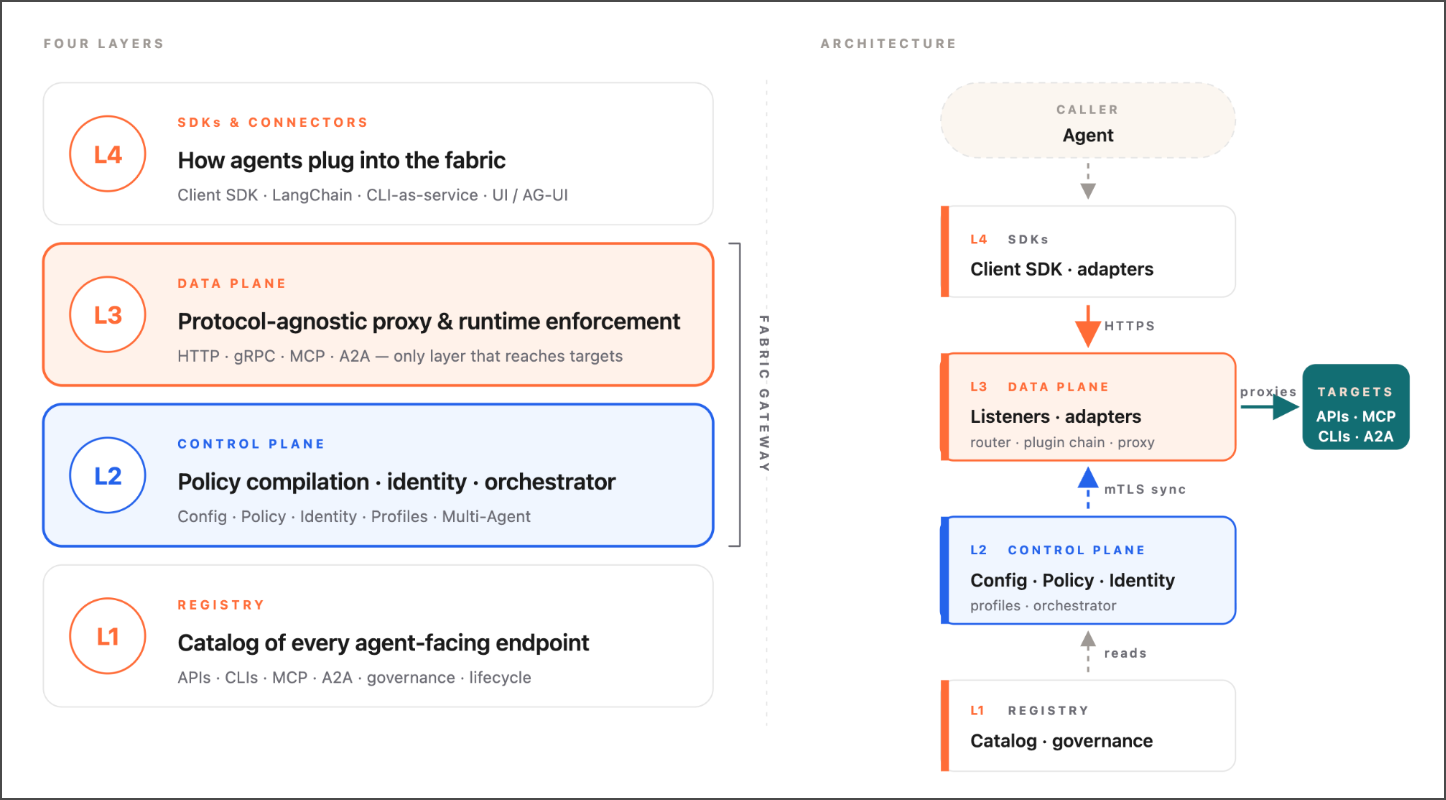
Fabric Gateway provides a four-layer system for agent traffic: registry, control plane, data plane, and SDKs and connectors.
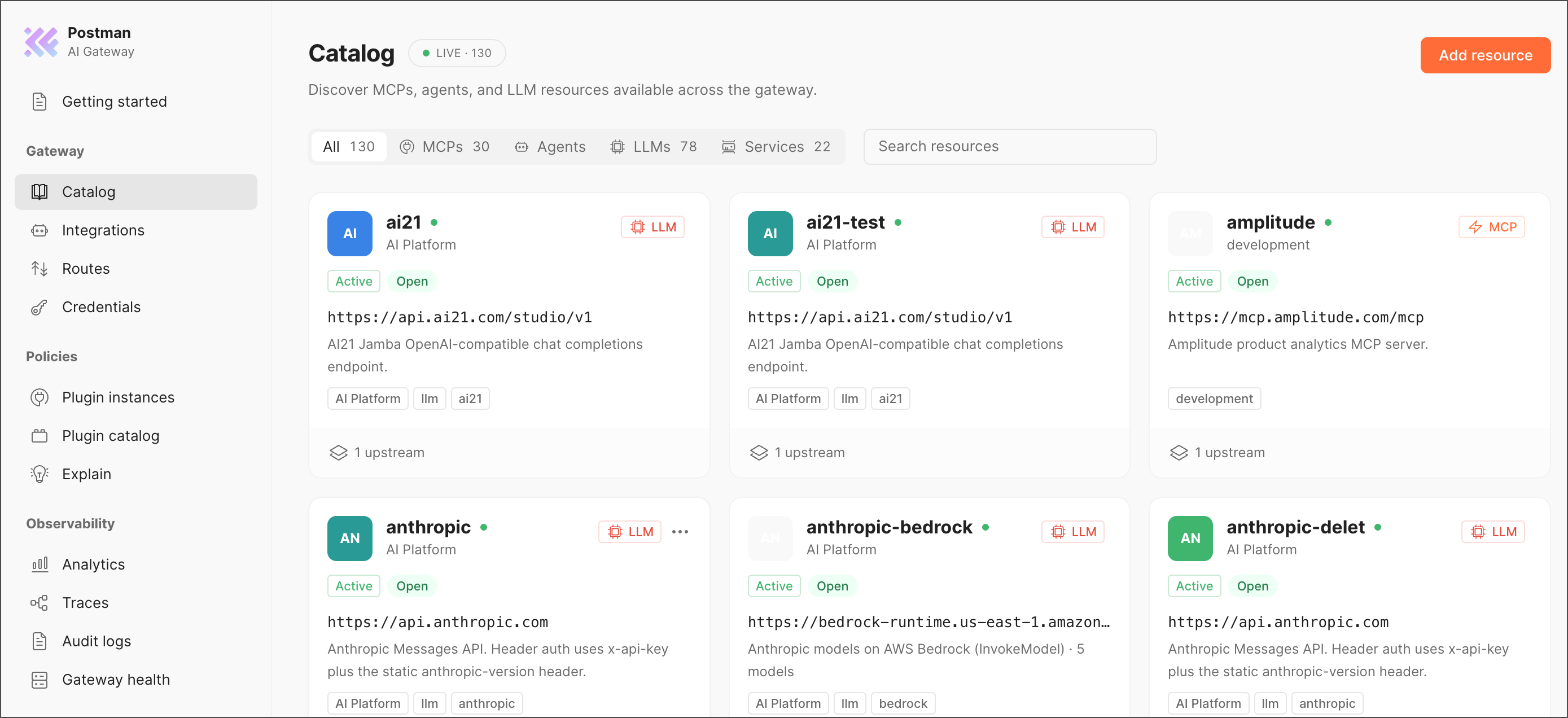
Use these Fabric Gateway sections to set up services, enforce policy, and monitor activity:
- Gateway — Catalog, integrations, routes, and credentials.
- Policies — Plugin instances, plugin catalog, and a tool to trace which plugin instances would run for a request, why others are skipped, and any warnings.
- Observability — Analytics, traces, audit logs, and gateway health.
Fabric Gateway enhances your agent ecosystem by providing the following capabilities:
-
Extends Postman’s Private API Network and governance into an agent-first interface fabric.
-
Generalizes today’s ad-hoc tool/MCP/CLI integrations into a single, policy-enforced plane for all agent-facing surfaces.
-
Enables multi-agent systems (MAS) to run over Postman-managed APIs and CLIs while giving security, compliance, and platform teams a single pane of glass for agent-level access, data-flow, and audit.
Who should use the Postman Fabric Gateway?
Fabric Gateway is ideal for organizations looking to securely and efficiently manage interactions between agents and APIs/CLIs. This includes the following personas:
-
Security and compliance — See and control all agent-to-API/CLI interactions, enforce least-privilege, and generate audit-ready reports.
-
Platform/infrastructure engineering — Manage a single, scalable control plane that unifies agent-facing traffic instead of maintaining a collection of MCP-style and CLI-style plugins.
-
Enterprise API product managers — Expose APIs to agents safely and governed, without custom tooling or risking accidental PII leakage.
-
Engineering managers and development leaders — Adopt agentic coding and ops (for example, coding agents, background agents) without blowing up security or governance.
-
Agent builders (internal teams and independent software vendors) — Leverage a simple, Postman-native way to plug agents into APIs, CLIs, and other agents with clear policy and identity semantics.
Core problems addressed
Postman Fabric Gateway addresses the following core problems:
Security model
- Dual identity validation — Every agent-to-agent request verifies both the agent token and the user context token.
- RFC 8693 token delegation — Purpose-scoped tokens per hop; the original JWT never forwards.
- Fail-closed — If policy can’t be verified, the request is denied, never passed through.
- Credentials never leave the gateway — Upstream secrets are injected by Fabric; agents never see them.
Deployment models
- Self-hosted in your VPC — Run the data plane inside your own Kubernetes cluster or VM fleet.
- Postman-hosted — Postman operates the gateway for you, with regional data planes.
- Hybrid — Postman manages the control plane while the data plane stays in your cloud.